
Digital infrastructure has a substantial physical footprint
Data centres may power the digital economy, but building them depends on a very physical supply chain. Steel, concrete, electrical equipment, cooling systems and computing hardware all need to be produced, transported and installed before a single workload can run.
That makes Canada’s data centre growth more than a technology or electricity story. It could create significant demand across manufacturing, trucking, rail, ports, warehousing, heavy-haul logistics and construction.
Natural Resources Canada estimates that electricity demand from Canadian AI data centres could reach three to five gigawatts by 2030 and potentially 10 gigawatts by 2050. Meta’s proposed C$13 billion, one-gigawatt project in Sturgeon County, Alberta, shows the scale of infrastructure that may follow.
These facilities are not simply buildings full of servers. They are complex industrial projects supported by power systems, substations, fibre networks, cooling infrastructure, roads, water systems and, in some cases, dedicated generation.
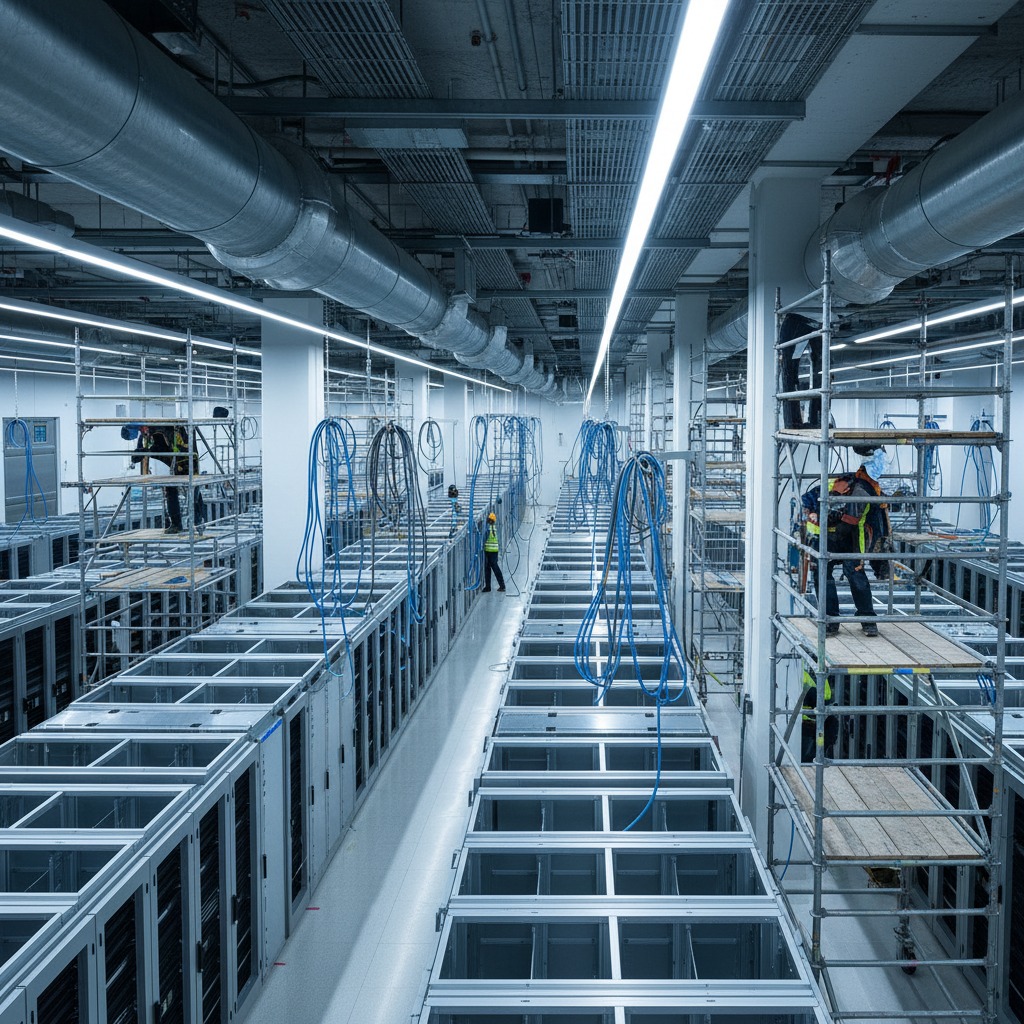
Why data centres require material intensive construction
The International Energy Agency identifies steel and concrete as important bulk materials used in data centre construction. It also notes that data centres require substantial quantities of copper, aluminum, silicon and other metals and minerals associated with electrical systems, computing equipment, energy storage and supporting infrastructure.
These materials enter a data centre project through several interconnected systems.
Structural and civil works
Steel may be required for structural framing, reinforcement, equipment platforms, roofing systems, stairs, pipe supports, security structures and external utility infrastructure. Concrete is used in foundations, floor slabs, equipment pads, roads, yards and other civil works.
Data centre floors must support densely installed technical equipment, while certain electrical and mechanical components require reinforced foundations or dedicated equipment pads. The amount and form of steel and concrete will vary according to the design, soil conditions, building height, seismic requirements, cooling technology and whether the project is constructed conventionally or through prefabricated modules.
Electrical infrastructure
A large data centre requires more than a standard commercial electrical connection. Its supporting systems can include utility substations, transformers, switchgear, busways, cables, control systems, uninterruptible power supplies, batteries and backup generation.
Copper and aluminum are particularly important because electricity networks and electrical equipment depend heavily on these materials. The IEA describes copper as a cornerstone material for electricity related technologies and notes that electricity networks require substantial quantities of both copper and aluminum.
Where a data centre requires a new transmission line, substation or dedicated generating facility, the project’s material and transportation footprint extends well beyond the data centre building itself.
Cooling and mechanical systems
High density computing equipment produces heat that must be continuously removed. Depending on the selected design, a facility may require chillers, cooling towers, heat exchangers, pumps, pipes, air handling equipment, water treatment systems and extensive mechanical controls.
These systems add fabricated steel, aluminum, copper and specialized machinery to the freight requirement. Some components may be manufactured domestically, while others may arrive through international ports or Canada–United States border crossings.
Servers and specialized technology
The final stage involves the delivery of servers, racks, processors, network equipment, storage devices and related electronics. Although these products are generally lighter than the bulk construction materials, they are high value and time sensitive.
They may therefore require specialized warehousing, secure transport, controlled handling and tightly scheduled delivery. The freight impact of a data centre is consequently not limited to heavy bulk commodities. It includes a combination of heavy construction freight, oversized equipment, containerized imports and high value technology logistics.
How data centre construction translates into freight demand
The relationship between data centre growth and freight activity can be understood through four stages.
1. Moving raw and semi processed materials
Steelmaking inputs, cement inputs and other industrial materials first move to manufacturing and processing facilities. Some of this movement takes place before a specific data centre order is placed, meaning the freight effect can appear upstream in the supply chain rather than only at the construction site.
Rail is especially suited to moving heavy bulk commodities and containerized freight over long distances. Transport Canada describes freight rail as a mode specializing in heavy bulk commodities and containerized traffic.
2. Transporting fabricated components
Steel beams, reinforcement products, metal enclosures, ducting, piping, cable trays and equipment supports must be transported from fabricators to the project location. These movements are likely to rely heavily on trucking because construction deliveries must reach individual sites and comply with specific installation sequences.
Statistics Canada reported that Canadian fabricated metal product manufacturing sales reached approximately C$4.69 billion in April 2026, up 10.4% from April 2025. This figure covers the entire fabricated metal sector and should not be attributed to data centres, but it indicates the size of the industrial base through which data centre orders could flow.
3. Delivering oversized electrical and mechanical equipment
Transformers, generators, chillers and large prefabricated modules may require specialized trailers, route surveys, permits, escorts and lifting equipment. Delivery timing becomes especially important because major components cannot always be stored easily at constrained construction sites.
The logistical challenge is therefore not only the number of tonnes moved. Dimensions, equipment value, delivery windows, route restrictions and installation sequencing can be equally important.
4. Supplying the construction site continuously
Once construction begins, trucks deliver concrete, steel, prefabricated assemblies, electrical equipment and other materials according to the project schedule. A concentrated cluster of developments can create overlapping demand for trucks, drivers, staging yards, cranes and warehousing.
This effect would be strongest where several large projects are built in the same region and during the same period. Data centre freight demand may therefore be geographically concentrated rather than evenly distributed across Canada.
Where the Canadian freight impacts may emerge
The freight effects will depend heavily on where projects are developed.
Ontario and Quebec have established technology markets, large populations and substantial electricity and telecommunications infrastructure. They are also relatively close to steelmaking, manufacturing, rail corridors, major highways and Canada–United States border crossings.
Ontario is especially relevant to the steel supply chain. The federal government has historically identified Ontario as the centre of most Canadian steelmaking capacity. More recently, Global Affairs Canada reported that Canada’s annual steelmaking capacity had remained around 16 million metric tonnes in recent years.
Quebec also has an important steel fabrication base. In July 2026, the federal government announced support for ADF Group’s C$52.3 million modernization of specialized steel production facilities in Terrebonne and Métabetchouan. The investment was intended to strengthen domestic industrial capacity, although it was not announced specifically as a data centre initiative.
Alberta is emerging as another potential centre because of its land availability and energy resources. However, projects located outside established data centre and manufacturing clusters may require longer supply routes for specialized equipment. This could increase dependence on rail intermodal services, long distance trucking, western Canadian ports and cross border shipments.
Canada’s freight network is already highly integrated with international trade. In 2025, rail freight volumes were broadly stable, while intermodal container traffic grew. Transport Canada also reported that railways were increasingly moving goods through Canadian gateways and overseas markets.
These existing networks offer a foundation for data centre development, but major simultaneous projects could expose constraints involving terminal capacity, truck availability, specialized carriers, border processing and project site access.
Opportunities for Canadian industry
The expansion of data centres could create several industrial opportunities for Canada.
First, it could provide domestic demand for Canadian steel and fabricated metal products. This may be particularly relevant because Canadian steel producers are highly exposed to international trade. The federal government reported that slightly more than half of Canadian steel production was exported in 2024 and that more than 90% of those exports went to the United States.
Domestic infrastructure investment could therefore provide an additional market for certain Canadian steel products, subject to technical specifications, pricing, procurement rules and production capacity.
Second, data centre construction could support businesses involved in structural fabrication, electrical equipment, transformers, modular buildings, ventilation systems, piping and industrial controls. Statistics Canada reported that Canadian primary metal manufacturing sales increased by 6.7% to C$71.2 billion in 2025, although that figure covers all primary metals and should not be interpreted as data centre related revenue.
Third, the development pipeline could create opportunities for transportation companies offering specialized heavy haul services, secure technology transport, project cargo coordination and just in time construction delivery.
Fourth, logistics hubs near rail terminals, highways and major development areas could provide consolidation, temporary storage and sequencing services. These facilities could receive components from multiple domestic and international suppliers and release them to construction sites according to installation schedules.
Risks and constraints
The same development could create pressure on Canada’s supply chains.
Competing construction demand
Data centres will not be built in isolation. Canada is simultaneously investing in housing, transit, electricity networks, clean energy projects and public infrastructure. Data centre projects may therefore compete with other construction sectors for steel, concrete, transformers, construction labour, trucks and cranes.
Transportation costs
Freight costs can materially affect construction budgets, particularly for remote projects or components requiring specialized transport. Statistics Canada reported that prices charged by Canadian truck transportation businesses were 4.4% higher in March 2026 than one year earlier. Long distance general freight trucking prices rose 4.5% between February and March alone, partly reflecting fuel price effects.
These figures do not measure data centre logistics specifically, but they demonstrate that freight prices are variable and can become a source of project cost escalation.
Trade and tariff exposure
Not every required product will be available from Canadian suppliers in the necessary quantity or specification. Specialized electrical equipment, cooling equipment and computing hardware may be imported.
Canada’s steel sector is also deeply integrated with the United States. Changes in tariffs, quotas or customs arrangements could affect both the availability and price of imported inputs and the ability of Canadian producers to redirect output from export markets toward domestic construction.
Limited visibility over the project pipeline
A major analytical limitation is that Canada does not yet have a single public dataset connecting announced data centre megawatts with construction schedules, material quantities, sourcing locations and freight movements.
Natural Resources Canada has itself emphasized the importance of improved data and planning around the energy requirements of AI and data centres.
Without greater disclosure, transport agencies, municipalities and suppliers may struggle to distinguish between speculative project announcements and developments likely to reach construction.
What Canada should do next
To convert data centre investment into broader economic value, Canada should treat these projects as part of an integrated industrial and freight strategy rather than as isolated technology developments.
Governments and project developers could begin by creating a more transparent pipeline of credible projects, including their locations, expected construction periods, power requirements and major infrastructure dependencies.
Early supply chain mapping could then identify which steel products, transformers, cooling systems and other components can be manufactured in Canada and which are likely to require imports.
Project sponsors could also engage railways, trucking companies, ports and municipalities earlier in the development process. Heavy and oversized components may require route modifications, bridge capacity checks, road improvements or special delivery windows.
Procurement strategies could package demand in ways that give Canadian manufacturers sufficient visibility to invest in capacity. However, domestic content objectives would need to be balanced against cost, technical performance, project schedules and international trade obligations.
Finally, Canada should track not only data centre electricity demand but also the physical infrastructure required to support it. Measuring construction materials, freight routes, equipment imports and domestic manufacturing participation would allow governments to plan infrastructure and assess the true economic contribution of the sector.
Conclusion
Canada’s growing data centre industry will not exist only in the cloud. Every new facility will depend on physical flows of steel, concrete, copper, aluminum, electrical equipment, cooling systems and computing hardware.
The resulting freight demand will extend across rail, trucking, ports, intermodal terminals, warehouses and specialized project logistics. The precise volume cannot yet be calculated reliably because publicly available Canadian data do not provide standardized material quantities for the emerging project pipeline.
What can be established is the direction of the relationship: as credible data centre construction increases, demand for transporting construction materials and technical equipment will also increase. The extent to which that demand benefits Canadian steelmakers, fabricators, transport operators and workers will depend on project location, domestic production capabilities, procurement strategies, trade conditions and the ability of Canada’s freight network to support large, simultaneous developments.
The data centre boom should therefore be understood not only as a technology and electricity story, but also as a major construction, manufacturing and freight planning opportunity for the Canadian economy.
Sources and Further Reading
- Natural Resources Canada. A National Strategy for an Electrified Canadian Economy.
https://natural resources.canada.ca/energy sources/electricity infrastructure/powering canada strong national strategy electrified canadian economy - Natural Resources Canada. Best Practice Guide for Canadian Data Centres.
https://oee.nrcan.gc.ca/publications/statistics/dac/2024/index.cfm - International Energy Agency. Energy and AI: AI and Energy Security.
https://www.iea.org/reports/energy and ai/ai and energy security - International Energy Agency. The Role of Critical Minerals in Clean Energy Transitions.
https://www.iea.org/reports/the role of critical minerals in clean energy transitions/executive summary - Statistics Canada. Monthly Survey of Manufacturing, December 2025.
https://www150.statcan.gc.ca/n1/daily quotidien/260216/dq260216a eng.htm - Statistics Canada. Monthly Survey of Manufacturing, April 2026.
https://www150.statcan.gc.ca/n1/daily quotidien/260715/dq260715a eng.htm - Transport Canada. Transportation in Canada Annual Report 2025.
https://tc.canada.ca/en/corporate services/transparency/corporate management reporting/transportation canada annual reports/transportation canada annual report 2025 - Transport Canada. Transportation in Canada 2020: Overview Report.
https://tc.canada.ca/sites/default/files/2021 07/transportation_canada_2020_overview_report.pdf - Government of Canada. Support for the Canadian Steel Sector.
https://www.canada.ca/en/department finance/news/2025/07/support for the canadian steel sector.html - Global Affairs Canada. Canada’s State of Trade 2025.
https://international.canada.ca/en/global affairs/corporate/reports/chief economist/state trade/2025 - Reuters. Meta to Build C$13 Billion Alberta Data Center, Its First in Canada.
https://www.reuters.com/world/americas/meta build c13 billion alberta data center its first canada 2026 07 08/ - Associated Press. Meta Plans Billions for First AI Data Center in Canada.
https://apnews.com/article/922a7d15ab730ec53b934269fc00a0fa
